
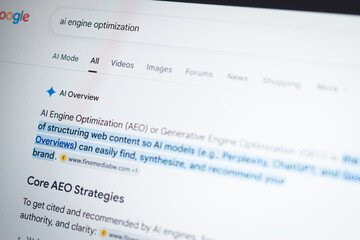
A page can rank well in Google and still face a different search experience than it did a few years ago. Google can now place AI-generated answers above traditional results, changing how users discover information and decide which sources to visit.
For Indian businesses, this does not mean traditional SEO is obsolete. It means the strategy needs to account for both conventional rankings and newer AI-powered search experiences.
Google’s own guidance says the fundamentals of SEO remain relevant for its generative AI features. The practical shift is toward creating useful, original, well-structured information that gives search systems enough context to understand the page and its subject.
The Shift From Traditional Rankings to AI-Generated Answers

Traditional Google Search typically presents a list of pages for a user to evaluate. AI Overviews can instead provide a generated response that brings together information relevant to the query.
That changes the user’s first interaction with search.
For example, someone searching for:
“How much does SEO cost for a small business in India?”
may no longer begin by opening the first five ranking pages. They may first read an AI-generated overview and then visit selected sources for more detail.
This makes visibility within the search journey more important than rankings alone.
It is also worth avoiding the idea that AI Overviews are a completely separate search system requiring an entirely new form of SEO. Google specifically states that its existing SEO best practices continue to apply to generative AI features.
The better approach is to strengthen the fundamentals while making content more useful and easier to understand.
What This Means for Organic Visibility?
AI-generated answers can change where and how users interact with organic results.
A business may still receive value from ranking traditionally, but the path from search query to website visit can become less direct.
This creates three practical considerations.
First, impressions are not the whole story.
Businesses should monitor clicks, qualified organic traffic and conversions alongside rankings.
Second, informational searches need stronger content.
If users can get a basic answer directly in search, a page needs to offer useful depth, examples, original insight or a clearer next step.
Third, brand visibility matters beyond individual rankings.
Search systems need to understand what a business does, which topics it covers and how its services relate to customer needs.
Google also confirms that AI features are reflected in Search Console reporting, making Search Console an important source for evaluating search performance rather than relying only on third-party rank tracking.
For Indian businesses, this makes it increasingly useful to evaluate SEO based on business outcomes, not simply keyword positions.
Content Characteristics That Support AI Visibility
There is no reliable trick that guarantees inclusion in an AI Overview.
Google’s current guidance instead emphasises established search practices and useful, people-first content. It also warns against scaled content created primarily to manipulate search visibility.
Content should therefore focus on clarity and usefulness.
Strong pages generally:
- Answer the main question early.
- Explain the subject accurately.
- Use descriptive headings.
- Provide useful supporting details.
- Include relevant examples or practical context.
- Link naturally to related pages.
- Demonstrate first-hand knowledge where appropriate.
- Avoid unnecessary repetition.
- Make important information accessible to search crawlers.
For example, a Mumbai dental clinic should not create multiple thin pages simply targeting variations of “dentist in Mumbai.” A stronger content system could explain treatments, suitability, preparation, aftercare, costs and location-specific considerations through genuinely useful pages.
The same principle applies to B2B, e-commerce, professional services and local businesses.
Our broader guide to AI SEO in India covers how this wider shift affects SEO planning.
How Businesses Should Adapt SEO?
The most sensible response is not to replace SEO with “AI SEO.”
Instead, improve the parts of SEO that already matter and make the website more useful across different search experiences.
Strengthen topical coverage
Build related content around important services, products, customer problems and industry questions.
A service page should connect naturally with supporting educational content rather than existing as an isolated landing page.
Improve internal linking
Internal links help users move between related information and help establish relationships between pages.
A website selling industrial equipment, for example, could connect product pages with application guides, comparison content, maintenance information and industry-specific resources.
Make business information clear
Clearly communicate:
- What the business offers
- Who it serves
- Where it operates
- Which industries or audiences it supports
- What makes its offering relevant
This becomes particularly important for local businesses. Google has also expanded AI-powered place and review summaries in India, showing how structured information about businesses and customer experiences can increasingly appear within AI-assisted discovery.
Improve technical SEO

AI search does not remove technical requirements.
Important pages still need to be crawlable, indexable and accessible. Site architecture, page performance, mobile usability, canonicalisation, structured data and internal linking should be reviewed as part of the normal SEO process.
A strong SEO foundation is therefore still the starting point.
Mistakes to Avoid
The growing interest in AI search has created several bad SEO shortcuts.
Publishing hundreds of AI-written pages:
Using AI to assist with content production is different from mass-producing pages with little original value. Google explicitly identifies scaled content abuse as a spam practice when large volumes of unoriginal content are created primarily to manipulate rankings.
Writing only for AI systems:
Content should serve customers first. Adding awkward entities, excessive definitions or unnatural keyword variations does not create a better website.
Ignoring traditional SEO:
Technical accessibility, useful content, internal linking and site architecture remain important for Google’s generative AI features.
Chasing guaranteed AI rankings:
There is no dependable formula that guarantees a page will appear in an AI-generated answer.
Measuring only mentions:
An AI citation or mention can be interesting, but qualified traffic, enquiries, sales and other business outcomes are more useful measures.
Practical Strategy for Indian Businesses
A practical approach can be built around six steps:
- Audit the SEO foundation: Check crawling, indexing, site structure, page quality and internal links.
- Identify important customer questions: Look beyond keywords and understand what customers need to know before choosing the business.
- Strengthen key commercial pages: Make service, product and location pages genuinely useful rather than purely promotional.
- Build supporting topical content: Cover relevant questions, comparisons, use cases and decision-making topics.
- Strengthen business and entity signals: Keep information consistent across the website, Google Business Profile and relevant external platforms.
- Measure the full search journey: Review rankings, impressions, clicks, organic conversions and qualified enquiries together.
The key lesson is simple: Google AI Overviews do not require businesses to abandon SEO. They make a strong SEO foundation more valuable.
Businesses that provide clear answers, useful depth, accurate information and strong topical context have a better foundation for both traditional search and Google’s evolving AI experiences.
For businesses reviewing their broader organic strategy, the next step is to assess whether the website’s current content and technical foundation are strong enough to support this shift rather than creating a separate AI-focused campaign from scratch.